Visa Services
Reimagining the User Experience for Visa Applicants
Overview
The National Visa Center (NVC) set out on a mission to significantly improve the customer experience for visa applicants by enhancing the clarity, usefulness, and consistency of the notices applicants receive throughout the visa process. These notices, essential touchpoints for applicants awaiting updates on their case status, were often difficult to understand, outdated, or mismatched with applicants’ expectations and needs.
In partnership with NVC leads overseeing this modernization effort, I guided research aimed at auditing and improving the existing notice ecosystem. This work included analyzing pain points, identifying information gaps, and uncovering opportunities to make communication more transparent and timely.
Simultaneously, I collaborated closely with the U.S. Digital Service (USDS) team working to redesign the public-facing visa applicant portal. Together, we ensured that improvements to notices aligned seamlessly with enhancements to the digital experience—creating a more coherent, user-centered journey for applicants navigating the U.S. visa process.
Role
Lead Designer
Lead Researcher
High Level Goals
The project aimed to identify which existing visa applicant notices had the greatest impact on the overall applicant experience and prioritize them for improvement.
By redesigning these notices to be clearer, more actionable, and better aligned with applicant needs, the work sought to strengthen the end-to-end customer journey and reduce confusion throughout the visa process.
A parallel goal was to modernize and enhance the applicant-facing digital portal, creating a more intuitive and fully digitized experience for visa applicants. Ensuring that the redesigned notices and the updated portal worked cohesively was essential—ultimately delivering a consistent, user-centered experience across every touchpoint.
Process at a Glance
Discovery
Scoping
Stakeholder Engagement
Research Strategy
Research Planning
SME interview Planning and Materials
On Site Research Planning and Materials
Customer Interview Planning and Materials
Interviews
SME Interviews
Observational Interview Study
Customer Interviews
Synthesis
Holistic Synthesis for SME Interviews
Holistic Synthesis for Observational Research
Holistic Synthesis for Customer Interviews
Final Insights
Final Research Deliverables
Research Report
Partner Notices Workshop
Notices Pilot
Design
Partner Engagement and Discovery
Design Ideation
Design Iterations and Final Concepts
Wrap Up
Lessons Learned
Impact
Discovery
Scoping
To establish a clear project direction, I facilitated scoping conversations with lead partners at the National Visa Center. Together, we clarified what each team needed from the work, ranging from improving the clarity of existing notices to enhancing the applicant portal and aligned on the areas that would deliver the greatest impact for visa applicants.
Discovery
Stakeholder Engagement
In my stakeholder engagement role, I facilitated discussions with key partners across the National Visa Center and USDS. Through these sessions, I gathered insights into their expectations and identified opportunities where improved notices and portal enhancements could have the greatest impact on both applicants and internal teams.
Research Strategy
Research Planning
The first step in thinking through the research phase of this project was to lay out in detail the research work required in order to best understand the applicants current understanding of notices sent out to them.
Another piece of this research was to gain a deeper understanding of current notices and their uses among Visa staff.
The outcome of the research planning phase was to tackle the research phase in three parts: Subject matter expert interviews
On site interviews (observational study)
Customer interviews
Research Strategy
SME Interview Planning and Materials
I took the lead on creating the interview framework for our SME research, including drafting the moderator guide, setting up collaborative note-taking systems, and establishing interviewing best practices. This structure helped the team gather high-quality insights efficiently and consistently.

SME Interview Planning Board

SME Moderator Guide

SME Interview Note Taking Template
Research Strategy
On Site Research Planning and Materials
Although moderated interviews revealed key applicant pain points, the research team recognized that notice challenges also stemmed from the internal processes behind them. To understand those processes in depth, a two-day onsite visit to the National Visa Center was planned. This firsthand perspective clarified how staff interpreted, prepared, and sent notices—insights that shaped solutions designed to improve the experience for applicants and staff alike.
I helped draft and finalize the observational research guide to guide questions in real time during the site visit.
I also took the lead on creating a note taking transfer space for not just this on site visit, but for other team members who went on additional international visits.

Observational Research Note Taking Transfer Framework
Research Strategy
Customer Interview Planning and Materials
Next, it was time to plan for the upcoming customer interviews. This phase of the research was one that I led, alongside other research team members.
To allow for seamless interview work, there was a number of planning and strategy materials to prepare, before the formal interview sessions started.
I created a moderator guide, a note taking template, a interview checklist, and formalize synthesis strategy to best prepare for interviews, and to start thinking about what the team would do with customer insights once they were collected.

Customer Interview Moderator Guide

Pre and Post Interview Checklist

Note Taking Template

Synthesis Strategy Workspace

Synthesis Strategy Snapshot
Interviews
Subject Matter Expert Interviews
After finalizing the materials for the three research streams, our team kicked off the research plan by conducting subject matter expert interviews. These conversations equipped us with the baseline knowledge necessary to maximize the value of the subsequent onsite visit.
To understand the operational perspective behind how notices were created, interpreted, and distributed, we conducted 10 moderated interviews with visa staff across a variety of roles. I led the execution of this research effort, moderating each session to ensure consistency in how questions were asked and insights were captured.
Throughout the interviews, I took detailed notes and facilitated structured debriefs with the team after every session to quickly align on emerging themes, surprises, and follow-up questions.
Given the project’s tight timeline, I also proposed and implemented a rolling synthesis strategy. Rather than waiting until all interviews were complete, we began synthesizing insights in real time, organizing observations, tagging patterns, and capturing early hypotheses as the research progressed.
This approach kept the team aligned, reduced the pressure of the final synthesis phase, and ensured that we entered the holistic analysis with a clear understanding of the most critical insights.
Ultimately, this method allowed us to work more efficiently and deliver higher-quality findings within a condensed schedule.

SME Interview Session Space
Interviews
Observational Research Study
After completing the rolling synthesis from our SME interviews, we made a strategic decision to pause the customer interview study and the broader synthesis work until after our onsite visit to the National Visa Center. We recognized that the context and operational insights gained during the visit would meaningfully shape how we interpreted and prioritized findings across all three research streams.
Anticipating the volume and complexity of insights we would gather onsite, I created a streamlined note-transfer template to support the research team once we returned. This template served as a centralized space for organizing observations, capturing workflows, and documenting emerging themes. My goal was to ensure that everyone had a clear, consistent structure for synthesizing findings and to intentionally bridge this upcoming round of research with the foundational knowledge we had already developed.
Once the template was in place, the entire research team adopted it during and after the onsite visit, making it easier to consolidate notes and prepare for collaborative synthesis.
Later in the project, I presented this framework—including how it supported our end-to-end research process—to more than 50 CA/CX DOS team members during a full-team sprint demo. This walkthrough helped demonstrate how our research approach enabled clarity, alignment, and scalability as we moved toward designing improved notices and enhancing the applicant experience
Interviews
Observational Research Study
The final component of our research plan focused on customer interviews. Although our staff research had already provided valuable operational insights, and revealed several informal findings that informed the broader visas project, we needed to understand the applicant experience with notices at a much deeper and more personal level.
I led this final research effort by moderating all customer interview sessions and guiding participants through their experiences, expectations, and pain points related to communications and notices they had received regarding the status of their applications,
The Visas team conducted 15 remote and moderated interview sessions.
In addition to facilitating the interviews, I served as the synthesis lead for this study as well as the two preceding ones, complete with a rolling, real time snythesis.
This allowed me to connect insights across all research streams and ensure that our findings reflected both the operational realities of NVC staff and the lived experiences of applicants navigating the notice process.

Customer Interview Sessions Space
Synthesis
Holistic Synthesis for SME Interviews
While I has completed rolling synthesis for SME interview sessions preceded both the observational research study and customer interviews, a complete synthesis was still needed.
Leading efforts with another research team member, we followed a synthesis framework to uncover robust and final insights that spoke to the staff experience when it came to all things notices.
The insights proved to focus more on the when and the why certain notices were sent out to different applicants. Barriers and staff pain points were also uncovered.

SME Interview Synthesis Board
The final insights found were used in an opportunities workshop with a partner team to uncover various focus of the expected notices pilot our team was working towards.
Synthesis
Holistic Synthesis for Observational Research
Once insights had been found for the SME study, it was time to focus more deeply on the observational research study, and what we found while on site with NVC. While this research study did pertain to the notices work that the visas team was working through, there was also an ask to share out these insights and learnings to the broader CX team as a way to documentation research work done and validate the work that we has been doing for a larger audience.
The observational research team was able to use the note taking transfer board that I had designed weeks early for this synthesis process, so that findings could be turned into insights, and used not just in notices work, but as a standalone, one off deliverable.

Observational Research Synthesis Board
Once synthesis was completed, the insights also provided the team with a working list of pilot ideas that would matter to both staff and improve communications with staff.
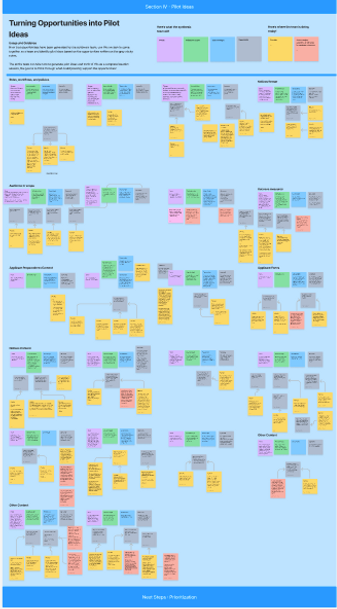
Insights as pilot ideas for visa notices
Synthesis
Holistic Synthesis for Customer Interviews
In the final phase of the Visas project, I led a holistic synthesis of customer interview data using a three-part synthesis framework I designed. This framework guided the team through note transfer, transforming themes into insights, and sharing out findings while outlining the research report.
Supported by a robust synthesis space, the process enabled the research team to move systematically from raw qualitative data to clear, high-impact insights. These insights directly informed a partner workshop and helped align stakeholders around key opportunities. As the synthesis lead within the design team, I ensured consistency, momentum, and alignment across the research team, driving synthesis to completion and elevating the overall quality of the output.

Customer Interview Synthesis Board
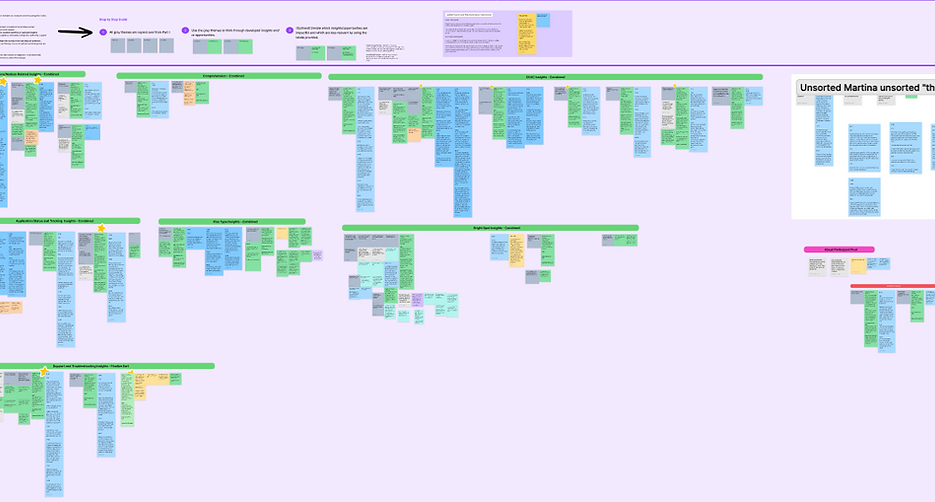
Insights Working Space
One of the most impactful parts of the synthesis framework, and while it worked so well was that it provided structure and a best practice for future synthesis work across teams.
This particular framework was adopted by teams across the CA/CX program as a way to ensure that impactful insights could be generated using a pre determined synthesis outline, able to be applied to multiple different workstream, regardless of the research study.
Synthesis
Final Insights
In the final phase of the Visas project, I led a holistic synthesis of customer interview data using a three-part synthesis framework I designed. This framework guided the team through note transfer, transforming themes into insights, and sharing out findings while outlining the research report.
Supported by a robust synthesis space, the process enabled the research team to move systematically from raw qualitative data to clear, high-impact insights. These insights directly informed a partner workshop and helped align stakeholders around key opportunities. As the synthesis lead within the design team, I ensured consistency, momentum, and alignment across the research team, driving synthesis to completion and elevating the overall quality of the output.
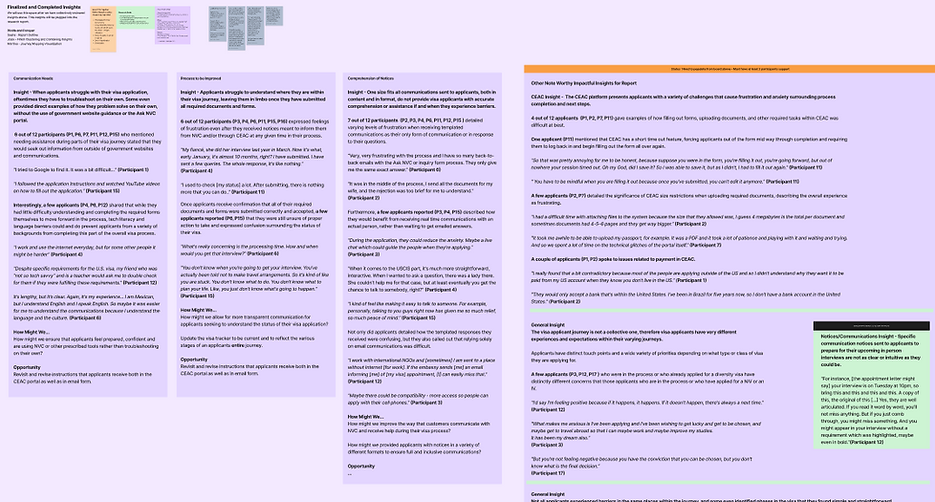
Final Insights
Final Deliverables
Formal Research Report
After wrapping up the synthesis for the three research studies for this project, the formal research report was written.
As a final deliverable, the customer insights that were formulated within the synthesis board were able to be plugged into a research report outline, for seamless integration.
Because of the semi sensitive nature of this contract, the research report can only be shown at a glance.

Customer Interview Research Report
Final Deliverables
Partner Notices Workshop
Although the Visas project encompassed three separate research studies that surfaced rich insights from both staff and customers, the ultimate objective was to translate this learning into actionable communication solutions.
To drive alignment and decision-making, I facilitated a partner insights workshop that grounded stakeholders in customer insights and guided them toward shared priorities. This workshop resulted in alignment around communication and notice concepts, which were ultimately selected and defined as a pilot for delivery.

Notices Workshop Board

'How Might We' Activity Breakdown
As the second phase of the workshop, I facilitated a viable solutions activity that built directly on the prioritized How Might We statements.
Partners used these statements as a foundation to generate a wide range of viable solution concepts, grounding their ideas in the robust research conducted by the Visas team. This activity created space for cross-functional collaboration while ensuring solutions remained rooted in customer needs and evidence.
By the end of the session, partners were aligned around a shared set of solution directions that balanced organizational goals with research-backed insights, setting a clear path forward for pilot development.
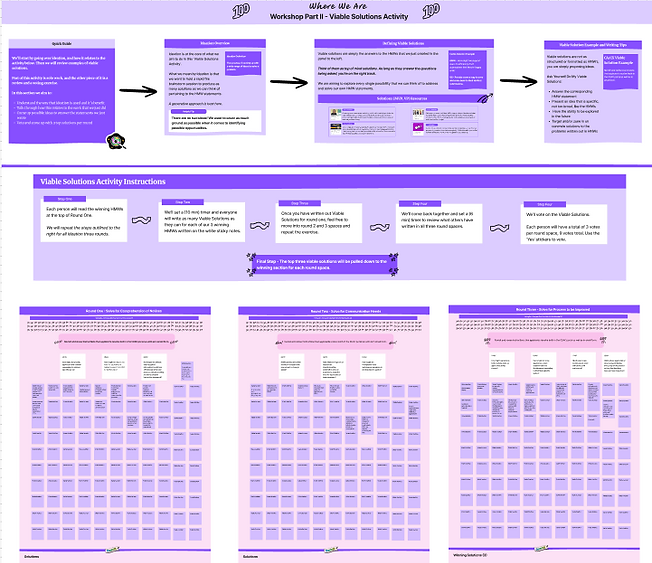
Viable Solutions Workshop Overview
Final Deliverables
Notices Pilot
Following the workshop, the Visas team advanced into a large-scale pilot directly informed by the outcomes I facilitated with NVC partners.
The notice identified as most impactful during the workshop was selected for further development, refined by the content team, and tested with customers to assess comprehension and response.
This pilot represented a significant milestone, one that would not have been possible without the depth of research I led and the stakeholder alignment established through synthesis and facilitation.
By grounding the pilot in robust, customer-centered insights, the team was able to confidently test meaningful communication changes at scale, generating actionable learnings to inform future improvements to the visa applicant experience.
Design
Partner Engagement and Discovery
As the notices research work was wrapping up, our team encountered a new opportunity: a request from a partner team leading the redesign of CEAC, the visa applicant–facing public portal.
While the notices pilot was actively running, I was asked to lead a series of partner engagement and discovery sessions in the form of design sprints with the USDS and engineering teams.
The goal was to bridge the gap between the robust insights generated through the notices research and the evolving needs of the CEAC redesign.
By grounding these sessions in validated customer learnings, I helped align cross-functional partners around shared insights and ensured that the CEAC redesign leveraged existing research rather than starting from scratch.
Design
Design Ideation
During the CEAC redesign effort, I led a design team of four and facilitated a series of ideation sessions to translate research insights into actionable redesign solutions.
I also led all calls with the USDS team, actively listening to their goals, priorities, and constraints, and bridging those with the findings from the notices research. By aligning the research insights with partner needs, we were able to generate a set of possible redesign solutions that were both customer-centered and feasible within the portal’s technical and operational constraints.
My role ensured that ideation was structured, collaborative, and directly informed by evidence, setting the stage for designs that were ready for rapid prototyping and testing.

Annotated Partner Brainstorm Board

USDS Brainstorm Board
Design
Design Iteration and Final Concepts
Throughout the CEAC redesign, I led a collaborative and iterative design process that brought together the design team, USDS partners, and engineering stakeholders. Leveraging the insights from the notices research, we engaged in rapid concept design and rapid prototyping cycles to quickly explore multiple solutions and test ideas in real time.
I facilitated design sessions to ensure each iteration addressed both user needs and partner requirements, creating alignment across teams at every stage.
By championing a structured yet flexible approach, I guided the redesign as it evolved thoughtfully, balancing creativity, feasibility, and evidence-based decision-making, ultimately producing solutions that were ready for implementation and pilot testing.

Partner Working Sesison Board

Applicant Type User Flows

Redesign Overview
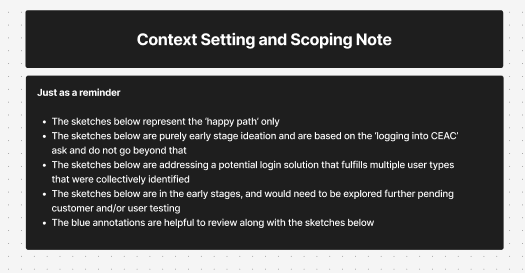
Partner Walkthrough Design Context
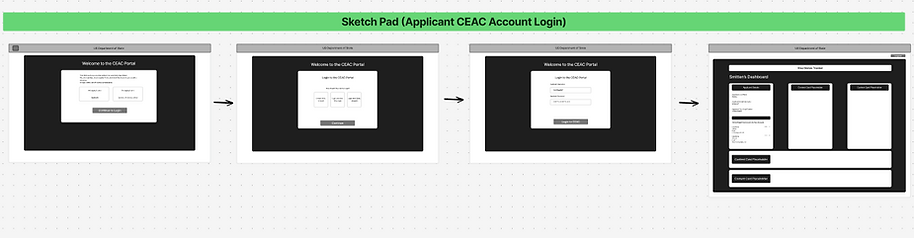

Final Concept Snapshots
The concepts developed through this iterative, collaborative process not only addressed user needs but also provided the USDS team with clear, actionable design directions grounded in research.
By leading the final walkthrough and framing the designs in the context of both insights and feasibility, I was able to demonstrate the strategic value of the work, resulting in several concepts being adopted for future development.
This outcome highlighted the impact of research-driven design and reinforced the importance of structured, collaborative leadership in shaping meaningful, implementable solutions for the CEAC portal.